
Did Heschmeyer Refute the AIT?
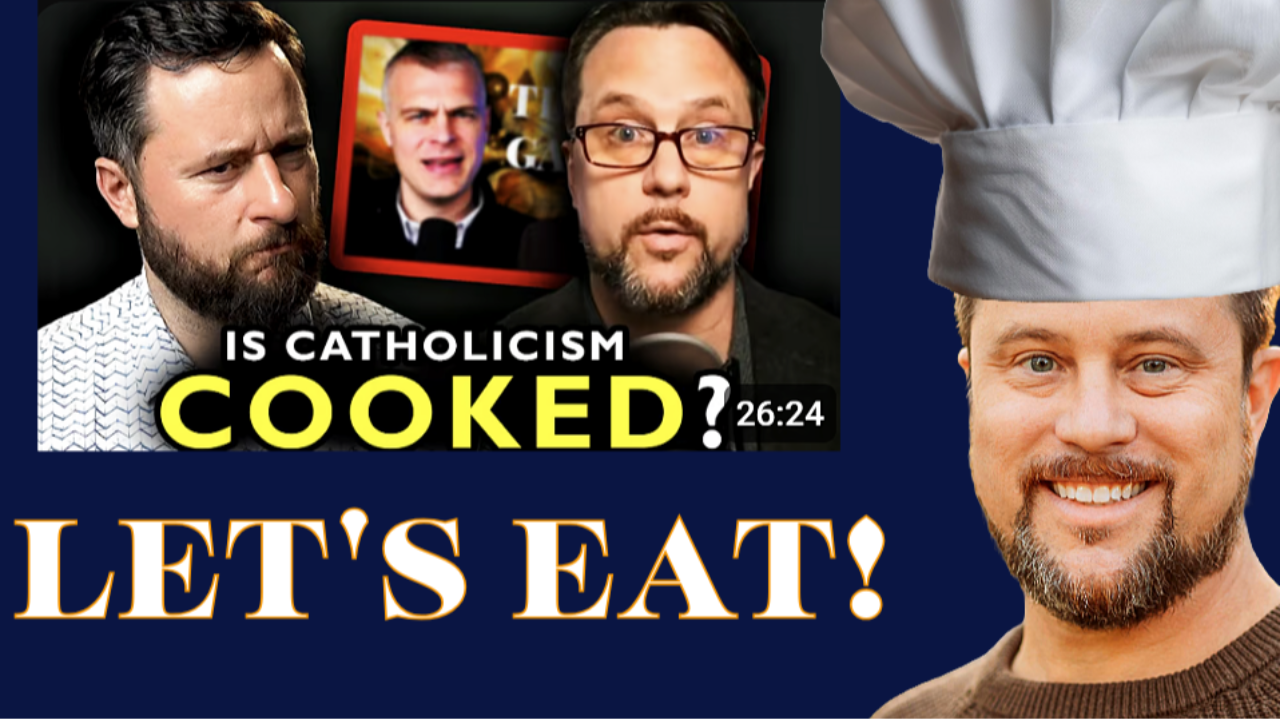
In Part 1 of my reply to Joe Heschmeyer's video on the Attribute Inscripturation Thesis (AIT), I put five distinctions on the table that clarified what the AIT actually claims and what it doesn't. The gap is metaphysical, not just logical. The argument is two-piece, with the AIT doing only the positive half. The modal scope is wide, not narrow. Exemplar causation is the mechanism, not generic supervenience. And kind-correspondence respects what each perfection governs.
Part 2 takes those distinctions and uses them to answer Joe's specific objections. Two of the five carry almost all the weight here, the mechanism (exemplar causation) and kind-correspondence, because nearly every objection Joe raises goes after a version of the AIT that drops one or the other. Joe's summary of my view, "Since God is the author of scripture, then scripture will necessarily reflect certain divine attributes," is reasonable shorthand. But the word "reflect" flattens a precise causal pathway into vague family resemblance, and that flattening is what most of the objections exploit.
There are various ways you can access my Part 2 reply to Joe:
- Article - The Protestant Review (Substack): https://protestantreview.substack.com/p/did-joe-heschmeyer-refute-the-ait
- Video - The Protestant Philosopher (YouTube): https://youtu.be/ifti_9lGlTw
- Audio - The Protestant Philosopher Podcast:
Here's where each objection lands when the real mechanism is back on the table.
Sufficiency, Deuteronomy, and the Last Supper
Joe stages a first-century Roman finding a scroll of Deuteronomy and asks whether my argument requires that scroll alone to be sufficient for that reader. He concludes that "sufficient" has slipped. The objection trades on a collapse Joe's own tradition doesn't accept. Reformed theology splits sufficiency in two. Material sufficiency, that Scripture contains all the content necessary for saving faith and practice. Formal sufficiency, that the text delivers that content clearly enough that no external authority is needed to complete it. Dei Verbum 11 grants material sufficiency by Rome's own conciliar statement. The sufficiency Joe is actually attacking is formal sufficiency, which is a far narrower target than the Deuteronomy scene implies. The scene quietly attacks ground we share rather than ground in dispute.
Clarity, the Parables, the Ethiopian Eunuch, and Peter on Paul
The AIT's claim is distributed perspicuity, not uniform local transparency. Westminster 1.7 scoped it that way four centuries ago, and the Reformed tradition has never claimed every passage is locally clear. The parables in Mark 4 operate as instruments of judgment on hearers, not as ambient textual opacity. The eunuch passage turns in my hand, not Joe's. As Vanhoozer puts it, the eunuch "could understand the words and follow their grammar, but he could not say what the text was about. He knew the sense, but not the referent." Philip supplies the referent as a minister expounding the very scroll the eunuch is already reading, not as a magisterium adding content from outside. That's the ministerial role the AIT affirms throughout.
Ultimate Authority and the Church Christ built
Here Joe is right, and I said it first. He's correct that authority-of-Scripture doesn't yield authority-of-Scripture-alone. That was the entire burden of Distinction 2 in Part 1. The "sola" comes from the disqualification argument, not the positive thesis. Where we divide is whether the church can bear coordinate ultimate authority. A church operating ministerially, preserving, transmitting, teaching, applying the text, satisfies everything my argument assumes. I affirm it without reservation. What the argument rules out is a strong-constitutive Magisterium, one that supplies salvific content the text would otherwise lack. The 1 Timothy 3:15 pillar verse won't carry the architectural reading either. Turretin walked through this in 1685. The church is the pillar in a forensic and political sense, the way magistrates' edicts were posted against pillars so everyone could read them. A pillar that displays the law isn't the source of the law's authority.
There's a deeper point that turns the tables. Every foundational authority is self-authenticating, because you can't validate an ultimate authority by appeal to a more ultimate one. The live question was never whether someone in this debate rests on a self-authenticating authority. It's where it lands. I locate it at Scripture. Rome locates it at the church, which has to authenticate its own authority to function as the final court. Sola ecclesia is structurally the mirror of sola scriptura.
Self-Authentication and the Turnip
Joe presses two things, an inference move and a parody. The inference move says you can't get from God's being uncreated to Scripture's being uncreated. I never said you could. The AIT doesn't claim Scripture inherits aseity. It claims Scripture bears the textual analogue of what aseity grounds, which is authority that doesn't depend on external validation for its standing. Scripture isn't self-existent. It's self-authenticating. Different claim, on the page before the video. The turnip parody dies on kind-correspondence. A turnip has no communicative-act dimension, so the communicative perfections don't determine communicative properties in it. Remove the kind-frame and you can make any cause prove anything. Keep it and the turnip is just a turnip.
Luke and the "Human Digest"
This is one of the two genuine hits Joe landed, and it earns a precise answer rather than a brush-off. In the Tobit piece I had listed, among markers of intrinsic counter-testimony, that a text might "identify itself as a human digest of prior research." Joe turns it on Luke's preface and says that's exactly what Luke is doing. The reply is in the criterion as I actually stated it. The diagnostic isn't any single feature. It's the convergence of positional failure with intrinsic tension across both categories at the same time. Luke's preface is a description of careful method inside a book that passes all four positional properties. Tobit's profile is the inverse, four positional failures plus intrinsic tension. Still, this is the objection that did real work. Luke's preface is the right text to press, and it forced me to state the convergence criterion more sharply than I had.
The Canon, Hebrews, and the "Inspired Table of Contents"
Joe's broader canon objection is that believers disputed which books belong, no inspired table of contents was given, so an institutional recognizer is required. The objection runs on a false dilemma. Either the canonical process was infallible, requiring an infallible church, or it was fallible, leaving the canon uncertain. Mathison's distinction breaks it. Infallibility is the inability to err. Inerrancy is the actual absence of error. A fallible church can produce an inerrant recognition. And this isn't a uniquely Protestant reading. Vatican I itself locates canonicity in inspiration, not approval. The books are held canonical "not because she subsequently approved them by her authority… but because, being written under the inspiration of the Holy Spirit, they have God as their author." That's the recognition view, in a Catholic dogmatic constitution. The Old Testament precedent makes it decisive. God entrusted the OT canon to a fallible community with no infallible council for roughly fifteen hundred years, and Jesus and the apostles used the result without correction. The "inspired table of contents" demand also dissolves on its own terms. Inspire a twenty-eighth book and you'd ask the same question about it. The demand is an a priori refusal to let any document be self-attesting, which takes out Rome's own foundation before it reaches mine.
On Hebrews, Joe caught my second genuine overstatement. I'd written that "nobody" questioned Hebrews. He produced Luther, who in 1522 judged that Hebrews "cannot be put on the same level with the apostolic epistles." "Nobody" was too strong, and that's conceded. But notice what the correction leaves standing. The dispute about Hebrews was about authorship. The dispute about Tobit was about origin. The Lutheran tradition kept Hebrews. The Tobit dispute ran fifteen centuries and resolved only by conciliar decree at Trent. Fix one word and the trajectory contrast is untouched.
The Diagnostic Question and the Pastor Parody
Joe's central charge is that "which divine perfection failed?" is "a kind of emotional appeal," only convincing if you beg the question. He parodies it by asking why God wasn't "powerful enough to make your pastor infallible." The parody fails on three structural features that distinguish the real diagnostic from the parody. No classical pedigree. No shared-premise architecture. No parallel exemplar-causal mechanism. My diagnostic has all three, three witnesses three centuries apart across both traditions running the same inference from God's essential nature to Scripture's properties. The parody has none of them. Joe's deeper point I take without reservation. The question isn't about what God can do, it's about what God has done. The AIT is conditional, not absolute. Scripture didn't have to exist. Turretin had this in 1685 already, conditional necessity rather than absolute. So the apostolic-period worry, that sola scriptura wasn't operative in the late first century when living apostles were preaching binding doctrine orally, is correct and irrelevant. That's a pre-closure world. The argument is scoped to the closed canon and says nothing about the years the canon was still open.
So count it up. Sufficiency lands on formal sufficiency, the narrow point actually in dispute, while material sufficiency is something Dei Verbum already grants. The Deuteronomy scroll, the Last Supper, and the living-apostles era all sit before canonical closure, and the closure-scope was published, not improvised. The turnip and the pastor both dissolve under kind-correspondence. The canon objection runs on a dilemma the Old Testament breaks. The clarity objection refutes a uniform-transparency claim no Protestant makes. Two objections out of the set, Luke's preface and the Hebrews "nobody" line, reached the argument and sharpened it. The others reached a summary.
Joe's cleanest statement of where we actually differ is that Catholics "freely concede that God could have created a world in which sola scriptura is true," and that the real claim is "God can't create a world in which he gives us the Bible but not sola scriptura." That's fair, and I'll take the relocation gladly. It moves the fight off whether the diagnostic question is manipulative and onto whether, given the closed canonical act with its property conjunction, any non-theopneustos source can be a coordinate ultimate norm. That's the disqualification argument. That's the ground I want.