LIVE MASTERCLASS · CATHOLIC MIRACLES
Face the Strongest Catholic Miracle Case and Stay Protestant with a Clear Conscience
You don't need to be a scientist, a doctor or a historian. Grant that something extraordinary happened. The question that matters is whether it confirms Catholicism, and in two hours you'll learn to answer it.
Saturday, November 14 · 9–11 a.m. Pacific · Live on Zoom
Save My SeatThe Argument You Can't Stop Hearing
Joe Schmid says the Catholic miracle evidence is "manifestly better" than the evidence for the resurrection, and that "the total objective evidence rationally obliges Catholicism." Ethan Muse calls declining Rome "a heart issue, not a head issue."
Then come the videos. Hours of photographs, medical files, eyewitness reports and laboratory studies of Eucharistic hosts. You're not a physician or a solar physicist. You can't check them all, and answering one properly takes weeks. Then another one arrives.
So you're stuck with two bad options. Pretend the evidence isn't there, or wonder quietly whether honesty means becoming Catholic.
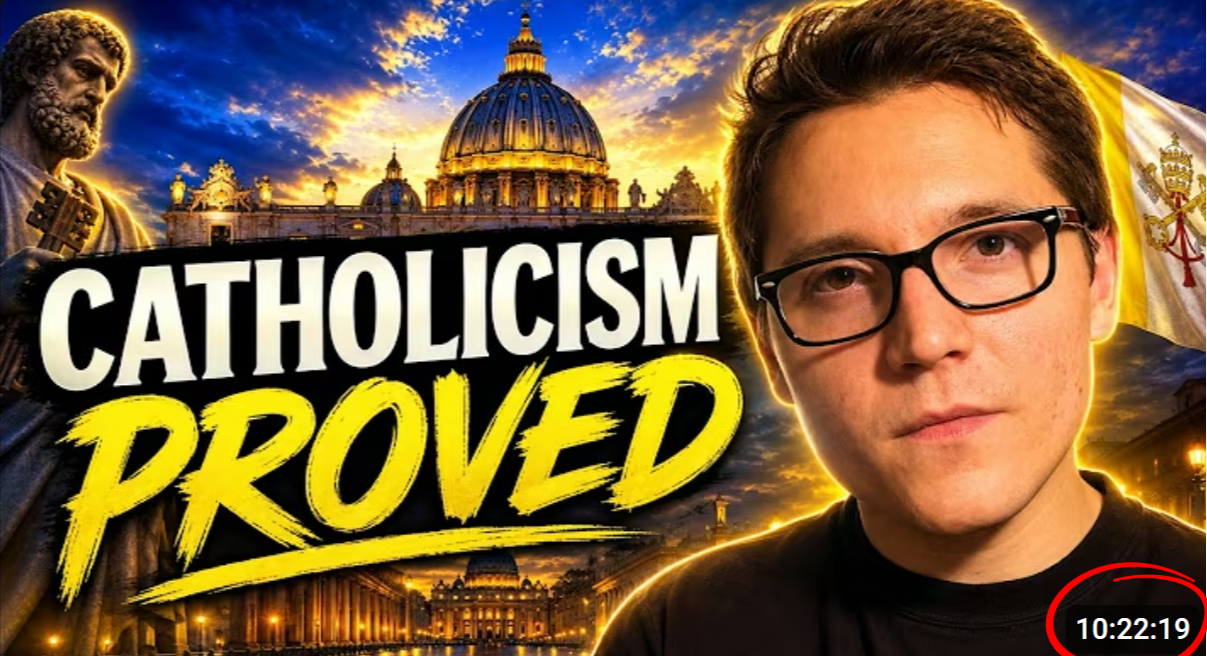
There's a Third Option
You don't have to win the fight over whether the miracles happened. Grant that something happened at Fatima, at Lourdes, at Lanciano. Then ask the question that actually decides things. Does it confirm Catholicism?
That's a question about what a sign proves, and you can answer it with careful thinking. One question settles every case. What was the sign declared to confirm?
Why grant everything? Because it's the strongest position there is. If I argued the miracles didn't happen, one new study could undo the case. Instead I give the other side what it wants on the evidence, and the conclusion still doesn't follow. No new video can change that, because the gap isn't in the evidence. It's in the step from "this happened" to "Rome speaks for God."
No fraud. No demons. No claim that Catholicism is false. And we test Easter first, so you'll see the method isn't rigged against Fatima.
Saturday, November 14 · 9–11 a.m. Pacific · Live on Zoom
Save My Seat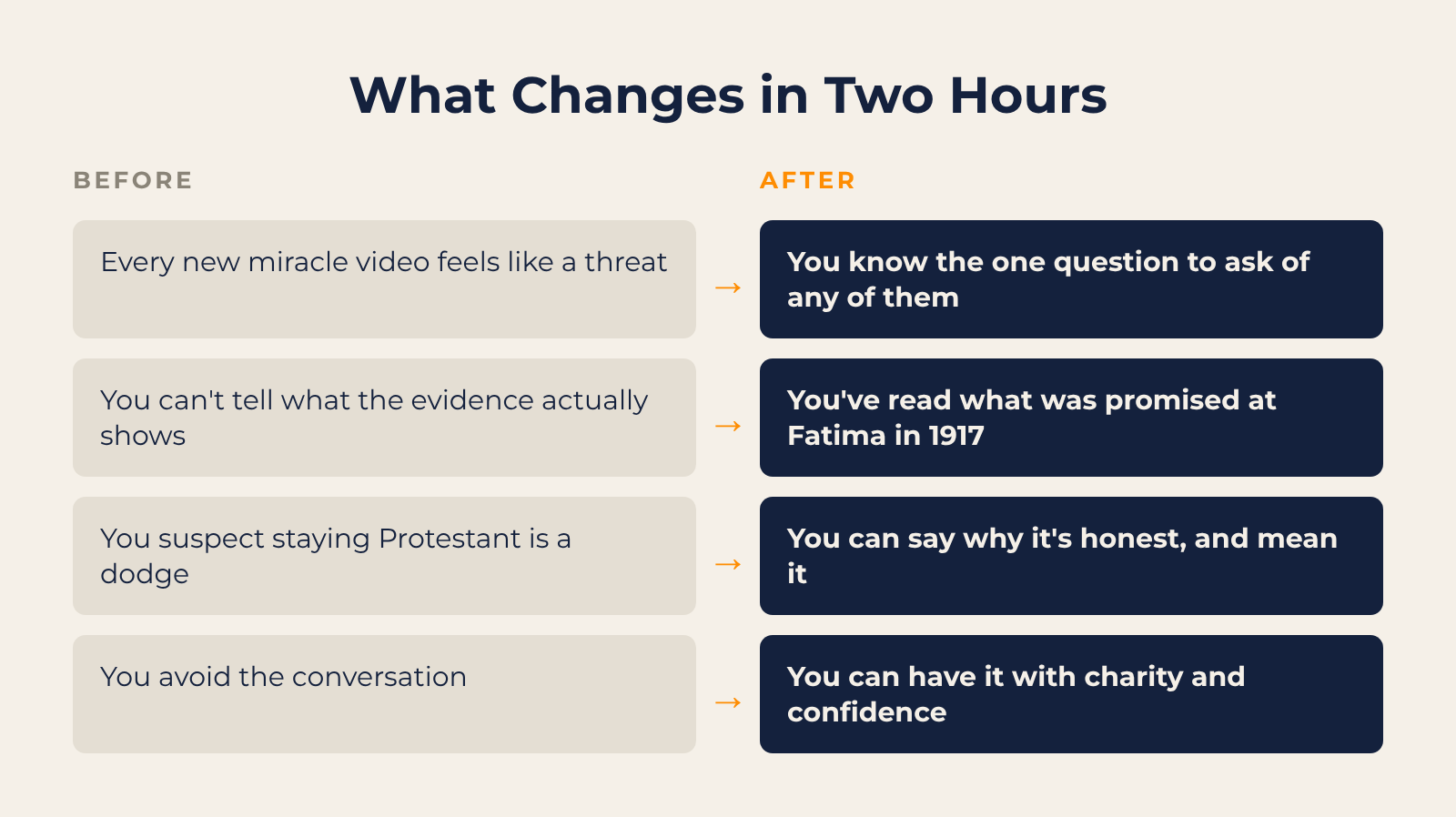
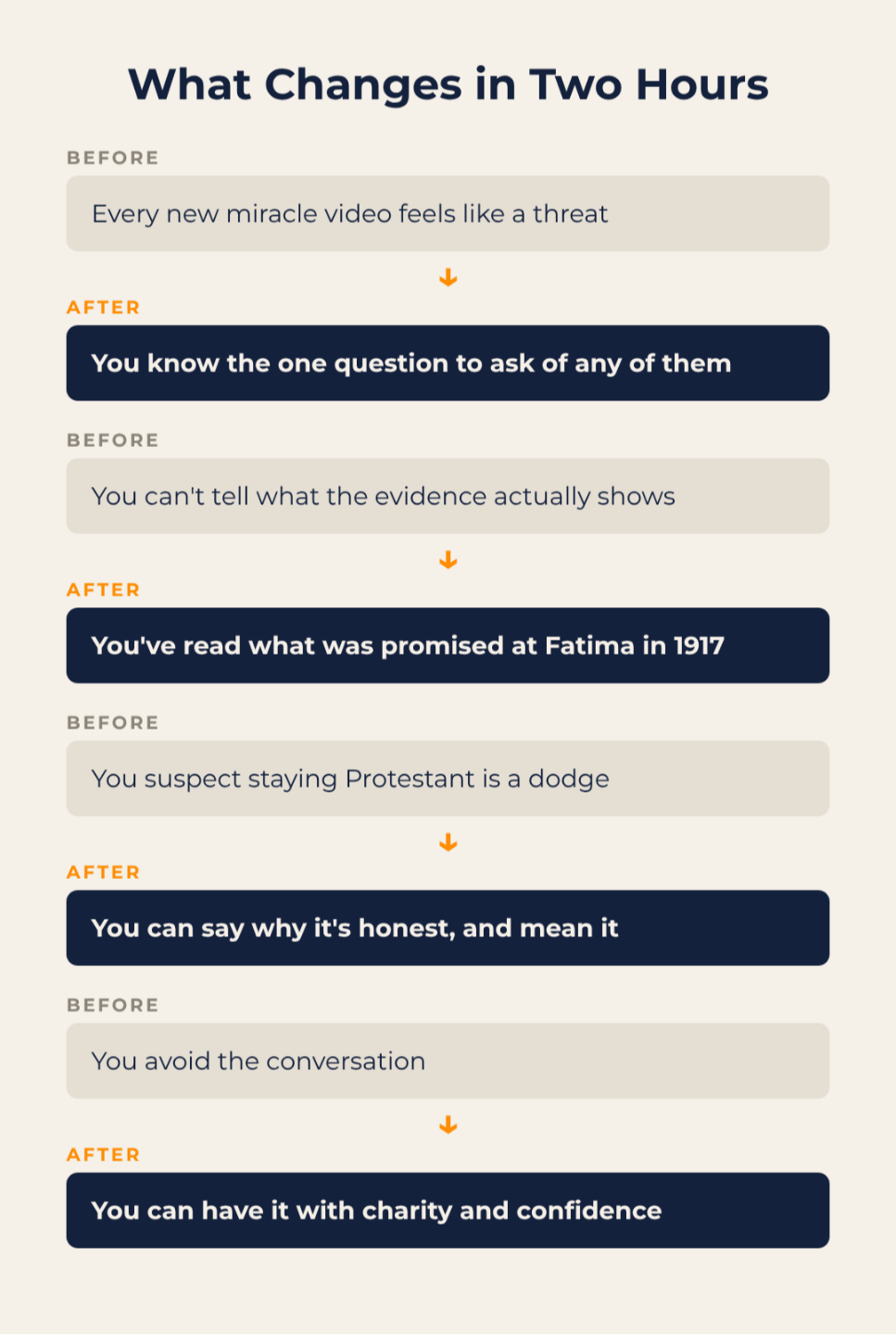
Three Things You'll Gain
Answer Any Miracle Claim
Run four questions on any miracle, from Fatima to the next viral video, and say exactly what it does and doesn't prove.
Distinguish the Fatima Evidence
Know what the 1917 Fatima record says was promised, and where the later papal content first appears.
Decline Rome With a Clear Conscience
Explain why an informed Protestant who keeps the resurrection and declines Rome isn't irrational, immoral or suffering from "a heart issue."
Inside the Two Hours
Part 1. The Principle
- The Dilemma: Why believing the resurrection doesn't commit you to Rome, even if the Catholic evidence is better.
- When a Claim Binds You: The two ways, and the four questions that test them.
- How Signs Confirm: Four cases from Scripture, and Garrigou-Lagrange on what a miracle can confirm.
Part 2. The Cases
- Easter: Why the resurrection passes the test.
- Fatima: What the crowd was told the sign would show.
- Zeitoun and Padre Pio: The control case Muse accepts, and the case that convinced Joe Schmid.
- Lourdes: The hardest case, including what I concede.
Part 3. The Objections
- The Pattern Argument: Why a run of Catholic miracles still doesn't oblige anyone to accept Rome.
- What Would Prove Me Wrong: On the record.
- Live Q&A: Thirty minutes for your questions.
Built On Catholic Sources
Vatican I, Dei Verbum, the Catechism, Cardinal Ratzinger’s commentary on Fatima, the Vatican’s 2024 norms on apparitions, the Church’s critical edition of the Fatima documents, and Garrigou-Lagrange.
Save My SeatThis is for you if...
- You're a Protestant who feels the pull of the Catholic miracle case
- You're a pastor or teacher whose people are asking about Fatima or Lourdes
- You're a Catholic who wants to hear the best reply to the obligation claim
- You've never studied the miracles but want to understand the debate
This isn't for you if...
- You just want talking points to win online arguments
- You want to hear that the miracles were faked
- You'd rather not meet the other side at its strongest
Why Listen to Me?
I kept seeing videos arguing that the miracles oblige me to become Catholic. Answering one properly took weeks, and then another arrived. So I stopped asking whether each miracle happened and started asking what each one was meant to prove. That question settled every case.
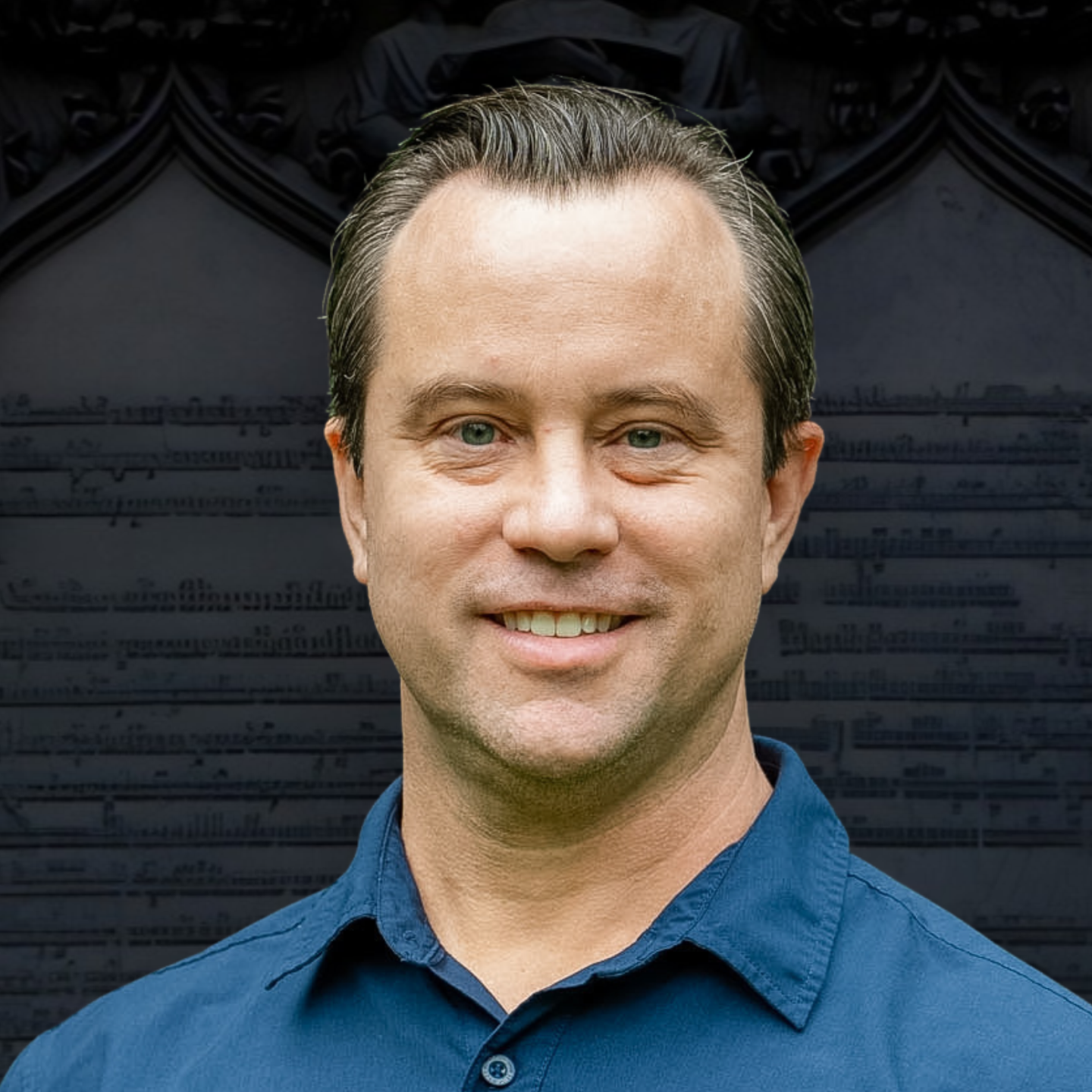
I'm Christopher Cloos. I hold a PhD in philosophy from UC Santa Barbara, specializing in epistemology, ethics, and philosophical theology. I've published in Philosophical Studies, Episteme and Philosophia Christi. I run The Protestant Philosopher on YouTube and The Protestant Review on Substack, and I recently presented this argument on The Analytic Christian YouTube channel. I'm a committed Protestant, and I've taken the Catholic miracle case seriously.
How It Works
- Enroll today. Your confirmation email arrives right away.
- Friday, November 13. Your workbook and the Objections and Replies handout arrive by email and in the course.
- Saturday, November 14, 9 a.m. Pacific. Join on Zoom with the link I'll email an hour before. Send questions in the chat any time.
- Can't make it live? The recording will be in the course within 48 hours, with access for a year.
Everything You Get
✓ The live masterclass, 90 minutes of teaching
✓ Live Q&A, 30 minutes for your questions
✓ The workbook, with every case worked through and the Four Questions card
✓ Four handouts: the 1917 Fatima record, the secret line by line, what Rome itself says about approved apparitions, and their claims set against the documents
✓ Objections and Replies, with Muse, Schmid and McKay in their own words
✓ The recording, with access for one year
✓ Your own question answered, in the chat or by replying to your confirmation email
The Object Test Guarantee
If The Object Test isn’t what you hoped, email me within 7 days of the live session (by Saturday, November 21) and I’ll refund every penny. No questions asked.
Enrollment Closes Thursday November 12
The $47 founding price is for this live cohort only.
Save My SeatQuestions Before You Join
Do I need a science or medical background?
Do I have to believe these miracles happened?
Why not just argue the miracles didn't happen?
Is this anti-Catholic?
I've never studied Fatima or Lourdes. Will I keep up?
What if I can't make it live?
What platform?
Can I ask my own question?
Face the Strongest Case. Stay with a Clear Conscience.
Two hours. One question. Every miracle granted, and a clear answer to the claim that you're obliged to become Catholic. I'll see you on the 14th.
Save My Seat